Our gut bacteria left Africa with us. Bringing them back is another matter
Two peoples on different continents, separated for tens of thousands of years, share more than 1,200 gut species — most of them now rare in industrialised countries.
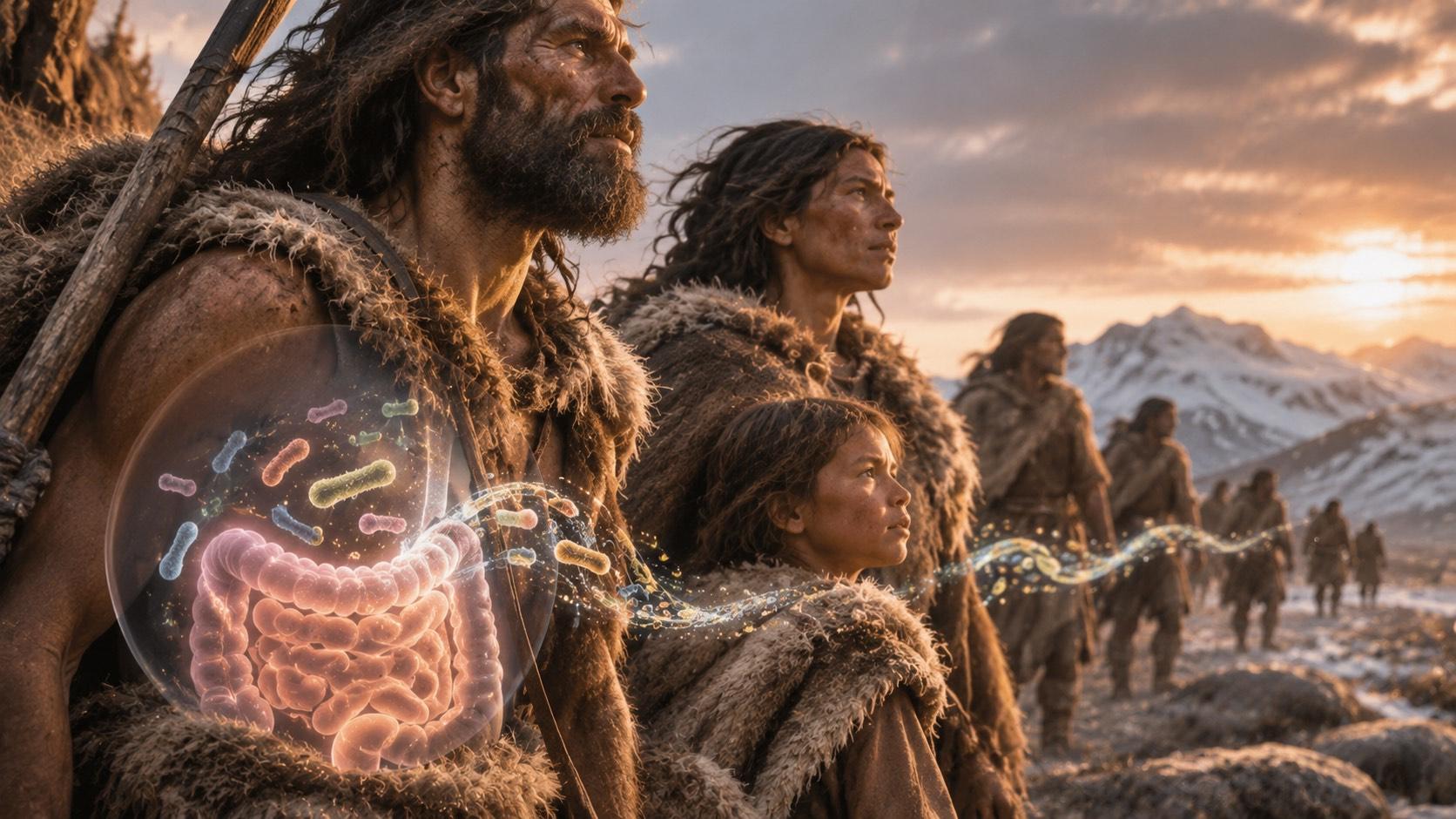
People in cities and people who live by hunting, foraging and small-scale farming carry strikingly different gut bacteria. Hunter-gatherers have many species that are rare or missing in industrialised countries; researchers call them "VANISH" microbes.2 The obvious question is whether these are ancient human companions that industrial life has stripped away, or simply local microbes picked up from the soil, water and food of each place.
A team at Stanford has now tested that with the bacteria's own DNA. Their answer: many of them have been travelling with us since before people reached the Americas.
What the researchers did
They deeply sequenced 133 stool samples from 85 Tsimane people, who farm and forage in villages in the Bolivian Amazon. They compared these with an earlier, similarly deep study of 137 Hadza hunter-gatherers in Tanzania.3 The ancestors of the two peoples parted tens of thousands of years ago and have had no contact since.
From the stool, the team rebuilt the genomes of the bacteria present: more than 12,700 genomes from about 1,400 species in the Tsimane samples alone. Then, species by species, they compared the Bolivian and Tanzanian versions. Bacteria pick up small DNA changes at a fairly steady rate, so the number of differences works as a clock: it shows roughly how long ago two populations of a microbe stopped mixing.
What they found
- Two continents, the same microbes. 87% of the species in the Tsimane (1,231) were also found in the Hadza. Of these shared species, 848 are rare in or absent from people in industrialised countries.
- Long separated. For 545 of the 636 species studied in depth, the Tsimane and Hadza had not shared a single strain in roughly the last 5,000 years. Their microbes were related, but had clearly been apart for a long time.
- The clock matches human history. The bacterial DNA puts the split at a median of about 17,000 years ago. That sits between humans leaving Africa (around 60,000–70,000 years ago) and reaching the Americas (around 16,000–23,000 years ago). For comparison, gut bacteria in Europe and North America last mixed about 1,000 years ago. A second, independent method, applied to 15 species, gave broadly similar dates.
- Some recent travellers. A few species, such as Akkermansia muciniphila and Bacteroides ovatus, were shared much more recently, with closely related strains around the world. These seem to have spread with modern contact, rather than with the ancient migration.
Put simply: much of the gut community that industrialised people have lost was not picked up locally. It was handed down from parent to child, and carried across the world as humans spread.
Reasons for caution
This is history, not health. The study measured no illness, symptoms or blood tests. It shows these microbes are old companions; it doesn't show that we're worse off without them.
The dates rest on assumptions. The bacterial clock depends on an estimated mutation rate, and the authors say plainly that their dates are approximate. The match with human migration is "roughly", not exact.
Two peoples are not all of humanity. The comparison rests on one group in South America and one in East Africa. Both are distinct communities, not stand-ins for "ancestral humans", and the samples were collected more than a decade ago.
Why it might matter
Other work fits the same picture. A separate study in Cell this year linked industrialisation to gut communities that are less varied, less stable and more alike from one country to the next.4 In mice, a low-fibre diet over several generations wiped out gut species that did not return when fibre was restored, unless the missing bacteria were put back.5 That was in mice, and nobody has shown the same in people.
The authors raise the idea of one day reintroducing lost species, and they rightly add that this would need to be done with, not to, the communities who still carry them.
What it means for you
Nothing to buy. No probiotic contains these microbes, and any product sold as an "ancestral" or "hunter-gatherer" microbiome is not backed by this study.
What industrial life removes first are the bacteria that feed on fibre. Eating plenty of beans, whole grains, vegetables and fruit is the one well-supported way to look after the microbes you still have.
The honest read
A convincing piece of microbial archaeology: many of our gut bacteria are heirlooms, tens of thousands of years old. Whether losing them is making industrialised people ill, and whether giving them back would help, are the questions that matter now. This paper doesn't answer them, and doesn't claim to.
References
- 1.Prehistoric global migration of vanishing gut microbes with humans Nature, 2026.
- 2.Seasonal cycling in the gut microbiome of the Hadza hunter-gatherers of Tanzania Science, 2017.↩
- 3.Ultra-deep sequencing of Hadza hunter-gatherers recovers vanishing gut microbes Cell, 2023.↩
- 4.Industrialization drives convergent microbiome and host physiological shifts in the human metaorganism Cell, 2026.↩
- 5.Diet-induced extinctions in the gut microbiota compound over generations Nature, 2016.↩