How a year in Antarctica changes your microbiome
Twelve scientists had their gut bacteria tracked through a year on the Antarctic ice.
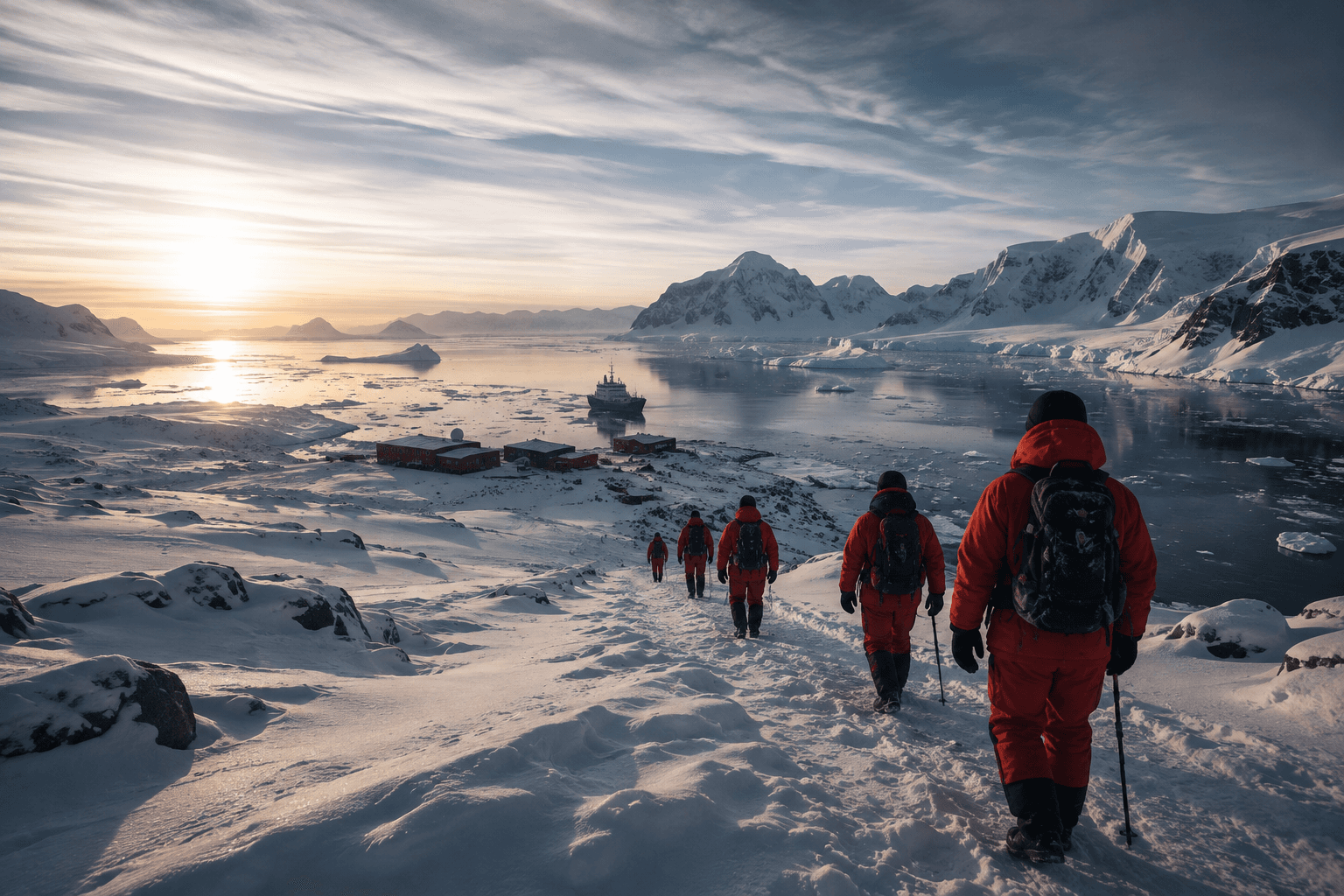
Send twelve people to the bottom of the world for a year — frozen food, no sunlight for months, the same handful of faces — and something ought to happen to the ecosystem in their guts. This study set out to catch it, and the top-line reads like it did: the microbiota "changed after one-year Antarctic deployment even after they left Antarctica." The trouble is a single missing sample, and it changes how much of that sentence you can believe.
What the study did
Researchers followed 12 male Han Chinese explorers (mean age ~43) stationed at Great Wall Station through a full winter-over, and sampled their stool at four points in Antarctica and once more seven months after returning to China. Sequencing was 16S rRNA, V3–V4 region on Illumina MiSeq — good enough to name genera, poor at species and strain. Alongside the stool they tracked a panel of blood markers: liver enzymes, lipids, uric acid, kidney indices.
The environmental contrast is the interesting part. In Antarctica the diet was frozen meat, frozen vegetables and yoghurt, supplied in phases; back home it returned to fresh meat, vegetables and fruit. A year of one diet, then a switch back — a natural experiment in what sustained dietary change does to the gut.
What it found
Diversity held; composition moved. Richness — Shannon, Ace, Chao1 — showed no significant change across the year (P > 0.05). But the overall community structure shifted, and here is the one result worth keeping: in ordination the final, back-in-China samples clustered with the late-Antarctic samples, not the earliest ones. Seven months home, the gut still looked like Antarctica.
At the edges, a few genera moved. The post-return samples were enriched for Escherichia-Shigella and Citrobacter — opportunists you don't particularly want gaining ground — and for Akkermansia muciniphila, the mucus-dweller this site covers in its encyclopedia entry, whose presence is harder to read as simply good or bad. A handful of genus-level shifts tracked blood markers: Anaerotruncus correlated negatively with ALT (r = −0.51) and GGT (r = −0.35); Citrobacter correlated positively with uric acid (r = 0.33). Modest associations, from a small sample.
The problem is the missing sample
Every headline here rests on the word changed — and to show change you need a before and an after. This study only has the after. The first stool sample was collected two months into the deployment, by which point the frozen diet, the isolation and the altered light had already been acting on these guts for weeks. The authors say it plainly in their limitations: they lacked baseline samples from the pre-deployment period.
That single gap undoes the strongest reading. "Antarctica altered the microbiota" is not something you can conclude when your earliest measurement is already inside Antarctica. What the data can honestly show is narrower: the community kept drifting during the stay, and had not snapped back to its earliest measured state months after return. That is a real, defensible observation — the gut is slow to revert after a long, sustained change in diet and environment — and it is quietly more interesting than the press-release version.
The other reasons to keep it small
Even granting the design, this is 12 men, all from one station, with the individual-to-individual variation the authors acknowledge. The taxa–blood associations come from univariate Spearman correlations, which the authors concede should really be linear mixed models that account for repeated sampling of the same people over time. The reference database (Silva v123) was, by their own admission, outdated. None of this is misconduct — it is an honest report of a hard study to run — but it is the difference between a hypothesis and a finding.
The honest read
A year in an extreme environment plausibly reshapes the gut, and the durable signal — a community that hadn't reverted well after return — fits what we know about how sluggishly the microbiome tracks a big dietary swing. Keep that. Discard the causal frame: with no pre-Antarctic sample, this cohort cannot tell you what Antarctica did, only what their guts looked like once they were already there. Read it as a well-caveated field note from twelve explorers, not as evidence that the ice rewired anyone.