Your gut reflects your diet, not your blood sugar
In 95 adults with prediabetes, diet tracked the gut microbiome — their glucose measures matched no bacteria at all.
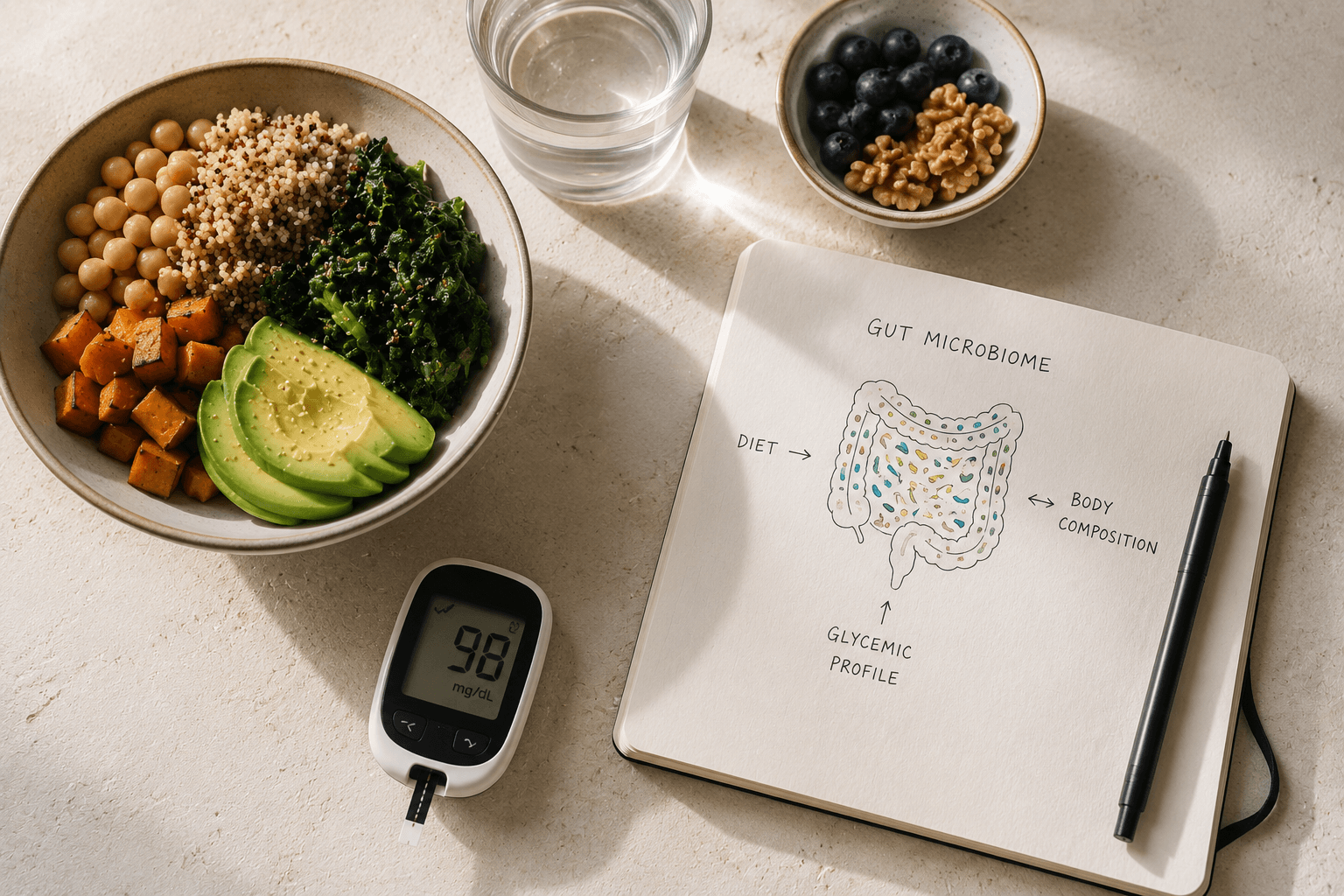
If the gut microbiome drives metabolic disease, then in people on the edge of diabetes it ought to track the things that matter — weight, blood sugar, how the body burns energy. A new analysis went looking in exactly that population, and what it found was quieter, and more honest: the microbiome mostly reflected what people ate, and only barely even that.
What the study measured
This is a cross-sectional, post-hoc analysis of baseline data from the Personal Diet Study, a randomised trial. The sample: 95 adults with overweight or obesity (BMI 27–50) and either prediabetes or moderately controlled type 2 diabetes (HbA1c 5.7–8%). Stool underwent metagenomic sequencing, paired with roughly two weeks of continuous glucose monitoring, indirect calorimetry for resting energy expenditure, bioimpedance body composition, and a 24-hour diet recall.
One structural caveat up front: the measures came in different subsets — diet in 63 people, metabolic data in 75, microbiome in all 95 — so the analytic sample shifts from model to model, which the authors flag as a source of bias.
What tracked the gut
Diet did the most work, and carbohydrate and sugar did most of that. But "the most" is relative: carbohydrate intake explained roughly 4% of the variation in community structure. The Prevotella-to-Bacteroides ratio — a much-cited diet marker — rose with carbohydrate (standardised coefficient 0.57), sugar, and total energy, and fell with monounsaturated fat, all consistent with prior work.
Body composition mattered, but in the direction this site keeps flagging: more fat-free mass went with higher diversity, higher BMI with lower — a reminder that diversity is a correlate of the body, not a verdict on health. A few host factors surfaced too: metformin tracked more Escherichia, and sex shifted a couple of genera.
What didn't track anything
Here is the part worth holding onto. The readouts you would most want the microbiome to explain in prediabetes — HbA1c and glucose variability from two weeks of continuous monitoring — were associated with no genus at all. Neither was weight-loss self-efficacy. In a study built to connect the gut to metabolic risk, the metabolic-risk measures connected to nothing.
A mirror, not a dashboard
The honest reading is that, in this population, the microbiome looks like a downstream reflection of diet rather than an upstream driver of blood sugar you could read off a stool sample. And it is a faint reflection: a single time point, one day's diet recall standing in for habitual intake, subsets that change with each model, and a single arm of a single trial. Cross-sectional by design, so it cannot speak to cause.
The honest read
That diet shapes the gut is not news, and this adds a careful, metabolically vulnerable cohort to the pile — a genuine contribution. What it does not support is the pitch that a stool test will read your blood sugar or personalise your plate. The strongest signal here is the oldest one — you are broadly what you eat — and even that explained only a few percent of the picture. Read it as a map of where to look next, not a test worth taking today.